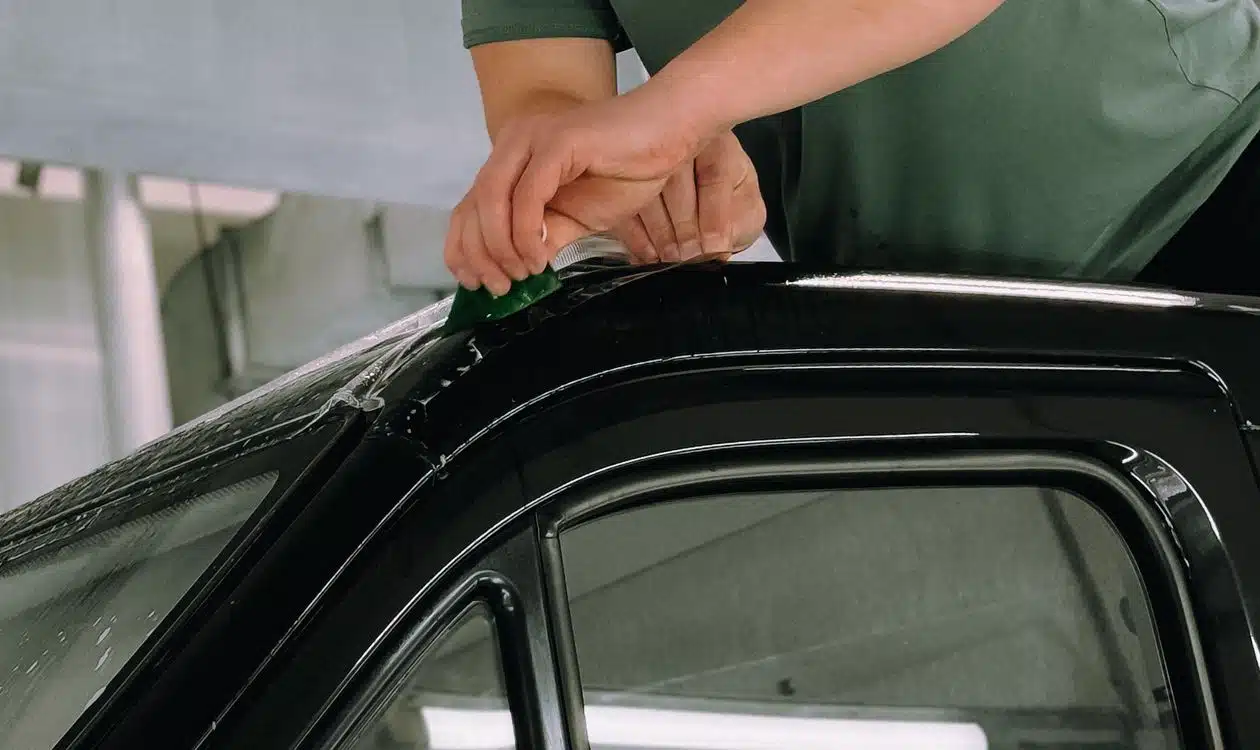
We install paint protection film every week in our shop, and the question we get more than any other is which is the best paint protection film for the money. Not what the marketing says. What actually holds up on a Porsche parked in Newport Beach sun for three years.
This is our honest take on the three brands we see most: XPEL Ultimate Plus, 3M Scotchgard Pro, and SunTek Ultra. Want the short version? Jump to the last section. When you’re ready to talk pricing or booking, our OC paint protection film services page has the details.
What Makes a PPF Brand Better? The 5 Factors That Actually Matter
Every PPF brand markets the same five things: self-healing, optical clarity, film thickness, warranty length, and pattern coverage. The differences show up in how well each one delivers once the film is on a real car in a real climate.
Here’s how we weigh them in the shop:
Self-healing speed and temperature. Every top-tier film heals light scratches. What varies is heat: some heal in ambient California sun, others need a heat gun. That matters if you don’t want to park in the sun after every wash.
Clarity and orange peel. Cheap PPF has a subtle texture that catches light wrong on dark paint. Premium films are visually invisible from a foot away. On a black or midnight blue car, this matters more than anything.
Film thickness. Most PPF sits between 6 and 10 mil. Thicker isn’t automatically better. It can stop more chips, but it stretches harder around curves and shows edges more.
Warranty coverage. Ten years is the industry ceiling. Read what it actually covers. Yellowing, cracking, and delamination are the failures that matter. Stone chips and installation flaws typically are not covered.
Pattern library. Nobody talks about this and it’s a big deal. If your installer doesn’t have a computer-cut pattern for your exact car, they’re hand-trimming on paint. Blades near your clear coat. We won’t do it, and neither should anyone else.
XPEL Ultimate Plus: The Industry Standard (Is It Worth the Premium?)
XPEL is what most high-end installers reach for by default, and it earned that spot for real reasons.
Ultimate Plus heals fine scratches in ambient temperatures. We’ve watched swirl marks disappear on a car sitting in our parking lot on a warm afternoon, no heat gun needed. In our experience, that’s the biggest day-to-day difference between XPEL and everything else. You don’t have to think about it.
The DAP pattern software is the other reason installers love XPEL. Patterns are cut fresh for each job on a plotter, and the library covers pretty much every car we see, including edge cases like a 2024 Corvette E-Ray or a low-volume Aston. That means we can wrap edges cleanly without razor blades near your paint.
The 10-year warranty covers yellowing, cracking, bubbling, and delamination. Warranty length only matters if the covered failure modes are the ones you’d actually see, and this one hits the real ones.
The downside is cost. In OC, a full front-end XPEL Ultimate Plus job runs meaningfully more than the same coverage in 3M or SunTek. For current ranges by coverage area and vehicle type, see our Orange County PPF pricing guide.
Comparing XPEL and 3M head-to-head with LLumar in the mix? The XPEL vs 3M vs LLumar PPF cost comparison breaks down what you actually pay for each brand and coverage tier in Orange County in 2026.
Worth the premium? If the car is worth protecting and you plan to keep it more than three years, yes. If you’re leasing something for 24 months and just want stone chip coverage on the hood, probably not.
3M Scotchgard Pro Series: Trusted Name, Real Trade-offs
3M has been in the film business longer than anyone, and Scotchgard Pro is a solid product. It’s also where we push back most on customer assumptions. The XPEL vs 3M paint protection film question comes up on almost every quote.
The healing is heat-activated. A swirl mark from a bad car wash won’t disappear on its own the way it would with XPEL. You need direct sun or a heat gun. In practice, you’ll live with more visible micro-scratches between details. Not a dealbreaker, but not the same experience.
Pattern coverage is thinner than XPEL’s. The pre-cut kits we’ve received from 3M often need trim work at the edges to look right. Some of our techs prefer bulk 3M film with hand cutting on templates because the pre-cut kits don’t fit as advertised. Fine on straightforward panels. Not fine on complex curves.
Where 3M genuinely shines is value. In our experience, for partial coverage (hood, fenders, mirrors, front bumper) without the absolute best clarity, Scotchgard Pro runs noticeably cheaper than XPEL for comparable coverage. For a daily driver in the $30–50K range, that math often makes sense.
Best-fit use case: partial front-end protection on a car you’ll own three to five years, in a color that hides minor imperfections.
SunTek Ultra: The Hydrophobic Dark Horse
The XPEL vs SunTek PPF conversation is the one we push customers to have more often than they expect. SunTek Ultra is genuinely competitive with XPEL on the metrics that matter, and it costs less.
The hydrophobic top coat is the standout. Water beads and sheds harder than any other PPF we install. On rainy days, the front end stays visibly cleaner. Bug splatter comes off with a rinse. That’s not marketing. It’s what we see when customers bring cars back for follow-ups.
Clarity is excellent. On a black car with fresh paint correction under the film, SunTek Ultra is invisible unless you’re looking for the edge. It heals in ambient warmth, similar to XPEL, though a touch slower in our observation.
In our experience, the manufacturer warranty runs 10 years and covers the same failure modes we see honored on XPEL claims: yellowing, cracking, bubbling, delamination. Same paperwork. Less money.
Where SunTek trails is pattern library. Their cut software is good, but not as deep as XPEL’s, especially on newer or lower-volume models. For a common car (Model Y, 911, Bronco) patterns are dialed. For something newer or rarer, XPEL usually has better coverage.
We install more SunTek than any other film for daily-driver customers. The price-to-performance is hard to beat.
Head-to-Head Comparison: Self-Healing, Clarity, Edge Lift & Warranty
Here’s how the three stack up on the attributes that actually matter for a car parked in Orange County:
| Film | Self-Healing | Clarity | Warranty | Hydrophobic Top Coat | Best For |
|---|---|---|---|---|---|
| XPEL Ultimate Plus | Ambient temperature | Excellent | 10 years | Yes | High-end cars, long-term owners, complex/newer models |
| 3M Scotchgard Pro | Heat-activated only | Good | 10 years | No | Partial coverage on mid-range daily drivers |
| SunTek Ultra | Ambient (slightly slower than XPEL) | Excellent | 10 years | Yes (strongest of the three) | Best value on daily drivers in the $50–90K range |
The warranty column looks identical, but field failure rates aren’t. In our shop’s records, 3M has produced more warranty claims for edge lift and slight yellowing than the other two combined. That doesn’t make it bad film. It’s still a working product. It’s why we don’t default to it.
Short version of the best PPF brand question: XPEL wins on pattern depth and ambient healing, SunTek wins on water shedding and price, 3M wins on partial-coverage budget jobs.
What Orange County Weather Does to PPF (Why Your Climate Matters)
Most PPF reviews are written by people who don’t live where you live. Ours is written by an installer who wraps paint protection film Orange County drivers actually put through it, in a climate that punishes film in specific ways.
Three things about Orange County matter for PPF:
UV intensity. SoCal produces more surface UV than most of the country. That UV is what turns cheap PPF yellow at the leading edges. In our experience, 3M Scotchgard Pro is more susceptible to slight amber tint on white and silver cars after year 5–6 than XPEL or SunTek. Not always. Often enough that we mention it.
Sustained heat. A car parked in an OC driveway in August sits at panel temperatures above 140°F for hours. That’s hard on adhesive. All three films handle it, but XPEL and SunTek’s adhesive systems have a small edge. We see fewer edge-lift call-backs.
Coastal salt air. If you park within a mile of the ocean, salt accelerates any weakness in the film’s edge seal. For coastal customers we recommend a quick edge inspection twice a year. XPEL and SunTek both handle it well. 3M is fine on protected cars, less predictable on daily drivers parked outside near the water.
If you’re comparing this to window tint, note that PPF and window film are different products with different brand hierarchies. Looking for a window tinting film comparison instead? That guide covers 3M vs LLumar vs SunTek vs XPEL for window film specifically.
Our Installer’s Verdict: Which PPF We Recommend in OC (and Why)
Here’s what we tell customers who ask us straight up which is the best paint protection film for their car.
Covering a car worth more than $80K, or one you plan to keep more than five years? Get XPEL Ultimate Plus. The ambient healing, the deepest pattern library, and the field record on OC-parked cars justify the premium. This is the pick for Porsches, McLarens, high-end Broncos, custom builds, and anyone who’s touchy about their paint.
Want the best price-to-performance ratio? Get SunTek Ultra. It’s the film we install most often on daily drivers in the $50–90K range. Hydrophobic behavior, ambient healing, 10-year warranty, meaningfully lower cost than XPEL. If you had a Model Y Performance or a 911 daily and asked what I’d put on my own car in your shoes, this is the answer more often than not.
Doing partial coverage on a lease or a mid-range car? 3M Scotchgard Pro is reasonable. Just go in knowing the trade-offs: heat-activated healing, more visible micro-scratches over time, and slightly higher risk of edge lift or yellowing over years 5–10.
The bigger truth: installer quality matters more than brand. A great installer with SunTek will produce a better result than a mediocre installer with XPEL. Ask any shop how many cars of your model they’ve done, whether they use computer-cut patterns, and whether they’ll show you a car they wrapped a year ago.
If you’re in North OC, our Huntington Beach shop is the closest location to book a PPF consult. Bring the car. We’ll pull the pattern for your model and walk you through what makes sense for how you actually use it.
FAQ
Which is better, XPEL or 3M PPF?
For self-healing, clarity, warranty performance in Southern California, and pattern coverage, XPEL Ultimate Plus outperforms 3M Scotchgard Pro. 3M is cheaper and still legitimate, especially for partial coverage. If budget isn’t the deciding factor, XPEL is the stronger choice.
What is the best brand of paint protection film?
For most customers in Orange County, the honest answer is either XPEL Ultimate Plus (best all-around) or SunTek Ultra (best value). Both offer ambient self-healing, 10-year warranties, and strong field performance in high-UV, high-heat conditions. 3M is a solid third option for partial coverage on daily drivers.
Will XPEL PPF turn yellow?
Modern XPEL Ultimate Plus has strong UV inhibitors and rarely yellows within its 10-year warranty period. If a customer shows us a yellowed film, it’s usually 8+ years old, a discontinued product, or a lower-tier film that was misrepresented at installation.
What are the drawbacks of paint protection film?
The main ones: upfront cost (a full front-end job runs into four figures for premium film), visible edges if the installer doesn’t wrap properly, and adhesive residue if you remove it after many years. On the right car with a good installer, none of these are dealbreakers. On a poor installation, all of them are.
What is better than XPEL?
Not much, honestly. STEK Dynoshield rivals it on clarity, and SunTek Ultra rivals it on hydrophobic behavior for less money. Some XPEL variants (Stealth for matte finishes) address use cases Ultimate Plus doesn’t. As a general-purpose gloss PPF, XPEL is at the top of the field.
Deciding between brands is only half the decision. If you’re outfitting a brand-new car, see our guide to whether PPF is worth it on a new car for how to think about coverage level before you pick a film.